
 Before you go to bed on Saturday night, “fall back.” Set your clocks backward one hour. If you live in Arizona, Hawaii, Puerto Rico, the Virgin Islands, or American Samoa, who do not participate in Daylight Saving Time, this doesn’t apply to you.
Benjamin Franklin, first jokingly suggested the idea that Parisians could, “economize candle usage by getting people out of bed earlier in the morning, making use of the natural morning light instead,” in a 1784 essay called “An Economical Project for Diminishing the Cost of Light” to the editor of The Journal of Paris.
He wasn’t far off the mark: By changing the clocks an hour forward or backward to better align with the earth’s spring and autumnal shift in angle to the sun, the number of hours one could work productively increased during those seasons and scarce resources used for heat and light (then oil and candles now coal, natural gas and electricity) could be preserved.
 Germany was the first to adopt the system in 1915 to save fuel during World War I. The British switched in 1916, and the United States followed in 1918, when Congress passed the Standard Time Act, which established our time zones. In 1920, the law was repealed. Dairy farmers opposed the time change, citing their cows, who can’t tell time.
 During World War II, Daylight Saving Time was imposed again to save fuel. Since then, DST has been used on and off, with different start and end dates. Currently, DST begins at 2:00 A.M. the second Sunday in March and ends at 2:00 A.M. the first Sunday in November.
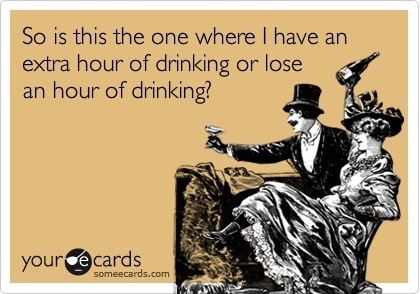 Officially the time when the change happens is Sunday morning at 2:00 AM. So, if you happen to be in a bar with a patron friendly owner, you may get an extra hour of bar time Saturday night. 😉 Hmmm
 Are you on Facebook? If you are interested in blog follow ups, things that make me wonder, laugh or scream about in frustration, join the more than 2,000 people who find me engaging or amusing: https://www.facebook.com/extremeblondemoments
 Extreme Blonde Moments