I feel really sorry for the athletes from around the world, who have spent years busting their asses to master their sports and make their countries’ Olympic teams, only to have to go to, what can only be described as, a gigantic cesspool, (Rio de Janeiro, Brazil) to showcase them.
Dead fish, dead animals, and even rotting corpses & body parts can be seen along the, what used to be picturesque, shorelines of Rio de Janeiro, Brazil. Even the most posh areas (Ipanema and Leblon Beaches) with steel and glass high rises cannot escape the filth. The lagoons that snake around them (and also around the nearby Olympic Village), “regularly sees massive pollution-related fish die-offs and emits an eye-watering sulfuric stench.”
Fisherman Jose Rubens told how he watched children haul a dismembered woman’s body from the waves of Guanabara Bay. Standing beside a gaping pipe spewing raw sewage straight into the bay, Jose, 56, unflinchingly shared, “They found a woman’s severed buttocks and upper legs three months ago. She was already starting to decompose. We didn’t tell the police. It’s not what people do here. We just pushed the remains back into the water.” (Source: Oliver Harvey, The Sun) These are the very waters that Olympic yachtsmen and wind-surfers will soon be competing for their countries in!
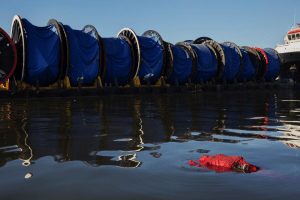
In 2009, Brazil used the awarding of the 2016 games as the motivation needed to “regenerate Rio’s magnificent waterways.” They pledged a billion-dollar investment meant to cleanup the tar-black Rivers; the lagoons near the Olympic Park with fluorescent green algae thriving amid sewage; the Guanabara Bay teeming with thick sludge that nearly swallows fishermen’s wooden boats; and to eliminate the giant brown stain that surfers must paddle out through to reach the beautiful blue surrounding waters.

Open water swimmers could very well have the worst of it though. Rio medic Dr. Daniel Becker said, “Foreign athletes will literally be swimming in human crap, and they risk getting sick from micro-organisms.”
Biologist Mario Moscatelli has spent the last 20 years studying Brazil’s polluted waterways. Every month he has flown over them by helicopter to note changes good or bad. “It’s been decades and I see no improvement,” laments Moscatelli. “The Guanabara Bay has been transformed into a latrine … and unfortunately Rio de Janeiro missed the opportunity, maybe the last big opportunity” to clean it up. (Source: Jenny Barchfield; AP)
Opening Ceremonies for the 2016 Summer Olympic Games are just 4 days away.
300,000-500,000 foreigners are expected to descend on Rio for the Olympics. They are likely in nowhere near the physical conditioning of the world class athletes they are coming to cheer on, and are much more likely to succumb to the viral illnesses that are the result of off the charts contamination of the most popular Rio de Janeiro beaches. Testing at several of the city’s world-famous beaches has shown that in addition to persistently high viral loads, the beaches often have levels of bacterial markers for sewage pollution that would be cause for concern abroad.
- In June 2016, Copocabana and Ipanema Beaches both had alarming readings for rotavirus, the main cause of gastroenteritis globally, with 7.22 million rotaviruses per liter detected in the waters of Copacabana, while 32.7 million rotaviruses per liter were found in the waters of Ipanema Beach.
- The testing also revealed alarming spikes in fecal coliform levels — the very measure the state government uses to determine the safety of Rio’s recreational waters.
“If these were the reported values in the United States, let’s say in California, there is definitely an indication of a problem,” said Dr. Kristina Mena, a waterborne virus expert at The University of Texas Health Science Center at Houston.
- According to California’s bacterial tests standards, 400 fecal coliforms per 100 milliliters is the upper limit for a beach to be considered safe for swimming. AP’s tests revealed that Copacabana Beach, where the marathon and triathlon swimming are to be held and thousands of tourists are likely to take a dip, exceeded California’s limit five times over 13 months of testing.
- Nearby Ipanema Beach, which is not playing host to any Olympic sports but is among the city’s most popular tourist spots, exceeded California standards five times over 12 months, once spiking to nearly 50 times what would be permitted in California. One of two testing spots along the beach in the Olympic hub neighborhood of Barra da Tijuca once hit more than 60 times that limit over the five months testing was conducted there.
The beaches even violate Rio state’s own standards, which are much less stringent than those in California. In California these beaches would be closed to the public until the source of the contamination was found and fixed and the water treated until tests came back with the water testing safe for the public to be in it again.
If you are a Tourist planning to attend the Olympic games in Rio beware: Water quality warning signs used to dot showcase beaches, but they’re no longer there. The water may not look infected but it is. Remember that the water flows across, carries, and deposits sand along the shoreline, so the sand is contaminated too…HMMM
The World Press has been paying close attention and has already reported a number of troubling things that the Athletes, Media, and those Tourists who may decide to travel abroad to witness the games, may encounter when they visit Brazil:
- A broken main caused untreated raw sewage and human waste to pour into the Olympic Village, where the World’s athletes are being housed and fed, over the weekend;
- Rotting corpses have been spotted floating at the rat-infested sailing and wind-surfing venue of Guanabara Bay;
- Athletes competing in events in the polluted Guanabara Bay are being told to ‘close their mouths’ for fear of contracting viral infections from waters poisoned by human excrement;
- Athletes have been robbed at gunpoint on the streets of Rio;
- Gun-toting thugs robbed Australian Paralympic sailor Liesl Tesch and team official Sarah Ross of their bikes while they were cycling in a Rio park;
- Between January and April of this year, there were 1,715 homicides in the city, a 15 per cent increase on the same period last year;
- A fire in the basement of the Australian team barracks overnight, forced all to evacuate the building. The alarms had been disabled and the only alert to the team was the smell of smoke! While they were out laptops and protective long sleeved anti-Zika clothing were reported stolen.
- Around 300 tons of trash are dumped in Guanabara bay every month — including condoms, discarded syringes, used toilet paper, old fishing nets, mangled furniture and other household trash;
- The spread of the Zika virus (now officially reported as having spread from infected male to female) has resulted in the top 4 golfers in the world, as well as many tennis players and other athletes, pulling out of the games;
- Body parts were found strewn on Copacabana Beach, right below the Olympic Beach Volleyball Venue.
As if threats to the health of athletes, media and tourists from the environment wasn’t enough, there are the threats of violence from the drug gangs and other thugs that rule the streets of Rio de Janeiro and now some scary threats reportedly coming from ISIS:
- After the Paris attacks in November a jihadi sent a tweet saying: “Brazil, you are our next target.”
- In May, ISIS launched a new social Portuguese-speaking media channel in a bid to attract new recruits.
- Brazil, used to dealing with armed drug gangs, has no experience in dealing with ISIS assaults.
- On July 15 Brazilian authorities deported a French-Algerian professor who had been convicted in France in 2012 of providing logistical advice to terrorist groups.
- Last week dozens of alleged IS sympathizers were held after claims they had discussed an attack on the Games.
When awarded the games, officials pledged to treat 80% of the raw sewage pumped into Rio’s Guanabara Bay, promised only to use the very cleanest sections of the Bay for competitions, and that there would be only minimal risk to sailors and other athletes. Now that the Opening Ceremonies are less than a week away and the proof of their inability to live up to their promises is being seen, smelled and reported worldwide, officials have had to admit that they have only been able to reach a sewage treatment percentage of 40%. That is obviously not acceptable for a city with a population of more than 12 Million, let alone one that is putting itself under the world wide microscope by hosting the Olympic games.
Additionally, Rio officials pledged that the athletes and visitors to their country would be safe, based on the reports of robberies within the village and in the surrounding areas, they are already failing on that front as well. It remains to be seen how Brazil is going to remedy the situation with just 4 days left before Opening Ceremonies, but I know one thing, the ravenous world press will not pull any punches in letting the rest of the world know just how deplorable conditions are. HMMM Indeed!
Are you on Facebook? If you are interested in blog follow ups, free or discounted stuff I find, things that make me wonder, scream like a maniac, laugh or yell in frustration, join the more than 2,600 people who find me engaging or amusing at the page dedicated to this blog: https://www.facebook.com/extremeblondemoments
 I am shamelessly cutting/copying and pasting the article below (thank you American Veterinary Medical Association) because of a story a friend shared today that really pissed me off! “Today at Target/Diamond Bar as I was going to my car, I saw a dog in a car in the parking lot. It was panting heavily and trying to stick its head out the couple-inch opening in the window so I went back in to ask the manager to page the owner. It had been half an hour since I walked by the dog!! When the owner came out she said it wasn’t that hot! SMH! Please remember dogs have a higher temp than us and cars get hot fast! PLEASE DON’T LEAVE YOUR DOG IN THE CAR!”
 Extreme Blonde Moments